
Tree Removal Cost Greer, SC
Typical 2026 Prices, What Moves Them and How to Get a Firm Figure
Most tree removals around Greer cost somewhere between about $200 and $1,100, and two local cost guides put the average for the Greer and Greenville area at roughly $525 to $540. Big trees are the exception: a large oak or poplar often runs $1,500 to $2,000 or more. These are typical prices across the Upstate in 2026, gathered from published cost guides, not a quote. The real number for your tree comes from a free estimate, and Backcountry Tree Service Greer gives you a firm figure at that visit before any work is booked.
Below, we break the cost down by height, show which local trees fall in each band, and list the extras that push a price up or down. If you already know the tree has to go, our page on tree removal in Greer explains how the job is done.
Which Height Band Is Your Tree In?
Height is the starting point for almost every quote, because a taller tree means more climbing, more cuts and more wood to move. Here's where trees that grow in yards around here usually land (heights from Clemson Extension and University of Florida tree fact sheets):
- Under 30 feet. Small ornamentals, young pines and trees that haven't reached full size yet. Often a quick job if nothing sits underneath.
- 30 to 60 feet. Many common Greer yard trees fall in this band. Bradford pears grow 30 to 50 feet, red maples 40 to 60, water oaks 50 to 60, and a loblolly pine in a landscape usually stays around 40 to 50.
- 60 to 80 feet. Willow oaks reach 60 to 75 feet, and sweetgums grow to a similar 60 to 75.
- Over 80 feet. Tulip poplars commonly reach 80 to 100 feet in a landscape, white oaks can reach 100, and a loblolly given room can grow to 90.

Tree Removal Prices Around Greer at a Glance
Typical 2026 price ranges for tree removal and the usual extras, all on the same scale so you can compare them.
Tree removal
- Most removals around Greer $200–$1,100
- Under 30 ft $150–$500
- 30 to 60 ft $450–$1,500
- 60 to 80 ft $800–$2,000
- Over 80 ft $1,200–$2,500+
- Crane-assisted removal of a very large tree $1,500–$2,500+
Extras
- Crane hire, per day $250–$600
- Stump grinding, first stump $120–$400
- Each extra stump $30–$70
- Hauling the wood away $50–$100
- Permit, where one is needed $60–$150
Storm and after-hours work: typically 1.5 to 3 times the price of the same job on a scheduled day.
Typical prices around Greer and the Upstate in 2026, from published cost guides. Not a quote: your free estimate gives the real figure for your tree.
Why Two Trees the Same Height Can Cost Very Different Amounts
A 50-foot water oak in an open back lawn and a 50-foot water oak hanging over a bedroom are not the same job. These are the things that move a quote within its band:
- Trunk width and wood. A thick trunk takes more cutting and leaves more weight to lower and haul.
- What's underneath. A roof, deck, pool, fence or neighbor's garage means the crown comes off in small pieces on ropes, which is slower than dropping the tree in one fall.
- The tree's condition. A dead or rotten tree can be brittle and unpredictable to climb, so more of it may have to be taken down from a lift or by crane.
- Getting equipment in. A back yard reached only through a slim side gate, a steep bank or a lawn that stays soft after rain all slow the work. Greer's red clay turns sticky when wet, and a loaded truck can rut a soggy yard, so wet spells can change how a job is set up.
- Power lines. Lines through the canopy change how the tree is cut. Before work starts near the line to your house, it may need to be switched off. If Duke Energy serves your home, it will disconnect the service line at no charge; Greer CPW customers should call CPW.
Cranes, Lifts and Taking a Tree Apart in Sections
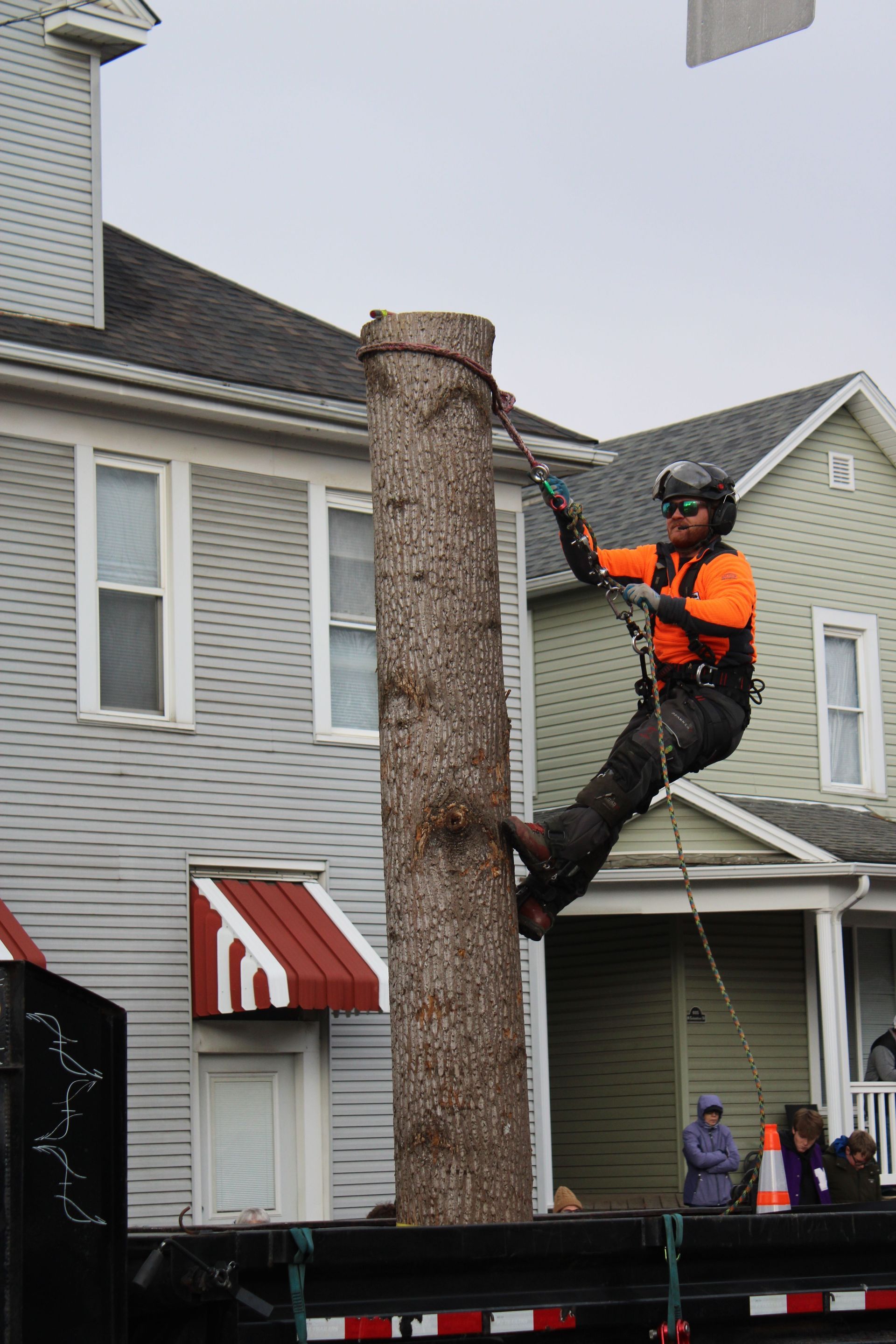
Most trees near a house come down piece by piece. A climber or a bucket truck takes the limbs off from the top, heavy sections are lowered on ropes, and the trunk follows in short rounds. That's the method behind most of the prices above.
Some trees are too big, too decayed or too close to a building to climb safely, and that's when a crane comes in. Cost guides put crane hire at roughly $250 to $600 a day on top of the crew, and a full crane-assisted removal of a very large tree often costs $1,500 to $2,500, with difficult jobs running to several thousand dollars. If your tree needs one, we'll say so at the estimate and explain why, so it isn't a surprise on the day. Read how we handle a tree removal in Greer near a house.
Extras That Change the Final Price
The height band covers cutting the tree down. A few add-ons are priced on top in most quotes:
- Stump grinding. Grinding the first stump typically costs $120 to $400, with Greer averages around $235, and each extra stump on the same visit usually adds $30 to $70. The process is laid out on our stump grinding in Greer page.
- Hauling the wood. Cost guides list hauling the wood away at about $50 to $100. Our estimates include clean-up and haul-away in the price you're given, and leaving the logs stacked for firewood means less to take away.
- A permit, where one is needed. National guides put permit fees at $60 to $150 in places that require one. The City of Greer's permits page lists examples such as decks, fences and pools, and tree removal isn't among them; if you're unsure, check with the city.
- Storm and after-hours work. Emergency removals typically cost 1.5 to 3 times a scheduled job, because crews work at night, in the rain or with the tree under tension.
Where the Wood Goes, and Why Hauling Costs Money
Disposal isn't free for contractors. Greenville County's disposal rates (effective July 2025) charge $5 a cubic yard for brush and trimmings under 6 inches across and 6 feet long, and bigger logs are charged under a separate rate by weight. Commercial haulers using a Greenville County facility must take it to the Twin Chimneys Landfill.
Inside city limits, the City of Greer's weekly curbside collection takes neatly stacked limbs, roughly eight cubic yards at a time, as long as no piece is longer than 6 feet or thicker than 6 inches. Anything over those limits isn't collected and has to go to the county landfill or leave with a contractor, so a whole tree won't go at the curb. If you live on the Greenville County side, the county's residential convenience centers take yard debris too, with a limit of three cubic yards per vehicle each day and proof of residence. That's fine for a few trimmed branches, but it's a lot of trips for a whole oak, which is why most people want the wood to leave with the crew.
The Cost of Doing It Yourself
Renting a chainsaw looks cheaper than a crew, but tree felling is one of the jobs where a mistake costs far more than the quote you were trying to avoid.
Know when to stop. Duke Energy advises that anyone who isn't a qualified professional should stay at least 10 feet away from overhead lines under 50,000 volts, so a tree with lines through it is never a DIY job. Clemson Extension singles out storm-damaged trees as among the riskiest to cut, since they are often unstable or loaded with tension. A tree that falls the wrong way onto a house, a car or a neighbor's fence can turn a few hundred dollars saved into an insurance claim.
A small, sound tree in an open yard is a different matter. If you can fell it with nothing in reach and you're confident with a saw, you may only need us for the stump.
Storm Prices and Price Gouging
Prices tend to climb after a big storm, because every crew in the Upstate is busy at once and the work is slower and riskier. After Hurricane Helene in September 2024, more than nine in ten Greer CPW customers were left without power. Then in January 2026, much of the Upstate was glazed with ice a quarter inch to a half inch thick.
South Carolina's price-gouging law gives homeowners some protection. Once the Governor declares a state of emergency, it covers services as well as goods, and an unconscionable price is judged against the average price in the 30 days before the declaration, unless the increase is explained by higher costs. The Attorney General's advice ahead of the January 2026 storm was to get at least three bids, ask for proof of both general liability and workers' compensation insurance, and never pay in full up front. If a tree is on your house right now, call (864) 334-7887 for our emergency tree service in Greer.
How to Get an Accurate Quote
A price over the phone is only a guess, because the things that move the cost are things someone has to see. You'll get the most useful estimate if you:
- Send a photo or two first, showing the whole tree and what's under it, so the right crew and equipment come to the visit.
- Point out the way in: gate widths, a slope, a septic field or a patch of lawn that stays soft.
- Say what you want done with the wood and the stump. Keeping logs or skipping the grind changes the figure.
- Get it in writing. South Carolina's Department of Consumer Affairs advises getting at least three bids, getting all the details in writing and asking for proof of insurance.
Backcountry Tree Service Greer works in Greer on either side of the county line, plus Taylors, Duncan, Lyman and Wellford. The estimate is free, the price is firm, and we're licensed and insured on every job.
Tree Removal Cost FAQs
Straight answers on what tree removal costs around Greer and what changes the price.
What's the average tree removal cost in Greer, SC?
Most removals around Greer cost about $200 to $1,100, with local cost-guide averages around $525 to $540. Large trees often run $1,500 to $2,000 or more. Your exact price comes from a free estimate at the tree.
How much does it cost to cut down a 30-foot tree?
Cost guides price trees up to 30 feet at about $150 to $500, and one Greenville guide puts a 30-foot tree at roughly $330 to $640. Expect more if it leans over a roof or a line.
What size tree costs $1,000 to remove?
Often a tree in the 30-to-60-foot band that needs extra care, such as a large water oak or red maple near the house, or a tree in the 60-to-80-foot band with easy access. Cost guides put that band at about $800 to $2,000.
What's the cheapest time of year for tree removal?
Cost guides advise booking in the off-season, late fall and winter, because spring, summer and early fall are the busiest seasons for tree crews. Dealing with a tree you're worried about before storm season also avoids the rush that follows big storms.
Does homeowners insurance pay to remove a tree?
Sometimes. The SC Department of Insurance says many policies cap tree removal at around $1,000, with a limit of $500 per tree. If the tree didn't hit a covered structure, the policy may only pay if it's blocking access, and damage from a rotten or neglected tree may not be covered. Check your policy with your agent.
Is stump grinding included in the price?
Not usually. Most quotes price it separately, typically $120 to $400 for the first stump and $30 to $70 for each extra one ground on the same visit. Tell us at the estimate if you want it and we'll include it in your figure.
Why is tree removal so expensive?
It's skilled, slow and risky work with expensive equipment: climbers, chippers, bucket trucks and sometimes a crane, plus insurance and disposal fees for the wood. Most of the cost is the care needed around houses and lines.
Can I get a price without a visit?
A rough range, yes, using the bands on this page. A firm price needs someone to see the tree, what's under it and how equipment gets in, and that visit is free.
Still have a question?
Phone us on (864) 334-7887 to talk through what your tree might cost, or fill in the form near the top of this page.